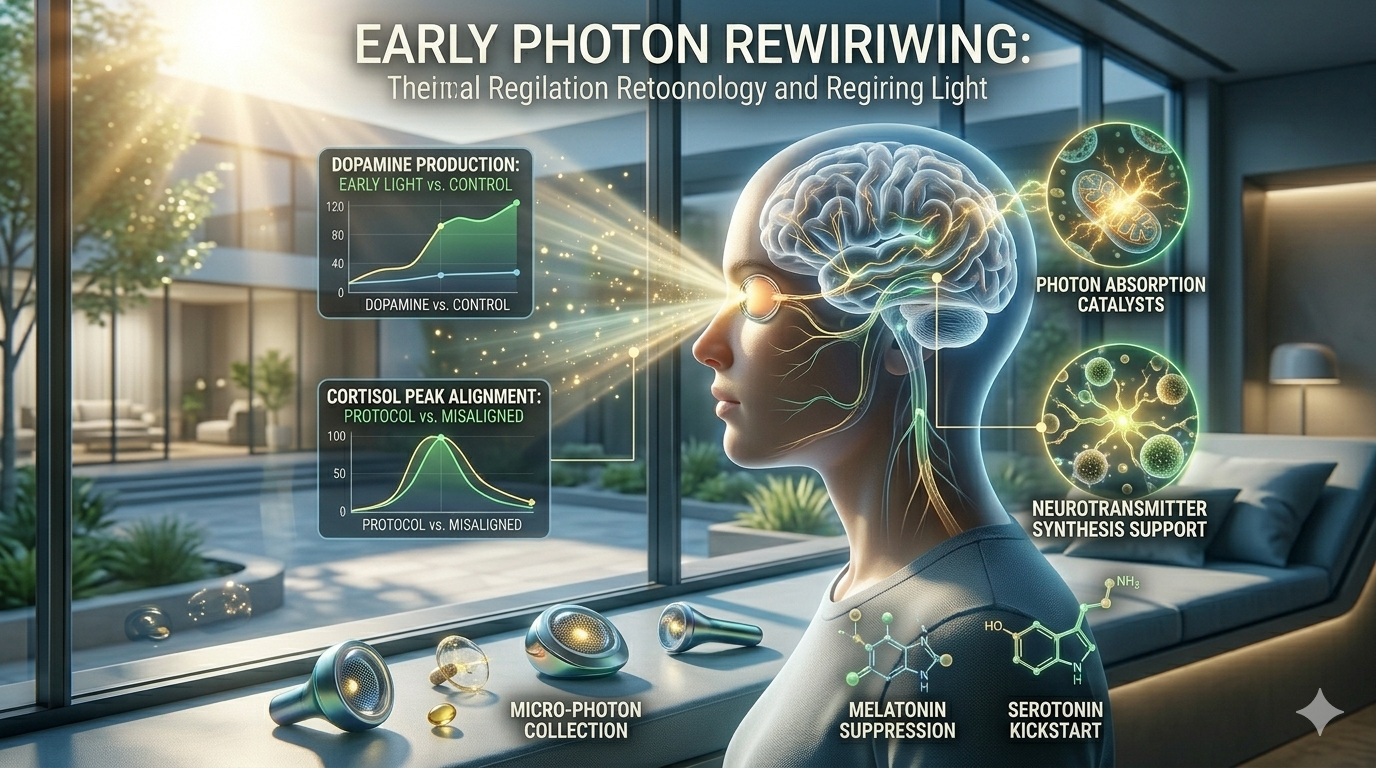
Why Your Brain Is Starving for Morning Light
Every morning, millions of Americans make the same mistake before their brain is even fully awake: they reach for their phone instead of executing a proper morning sunlight protocol to expose their eyes to natural daylight. That tiny habit seems harmless, but from a neurobiological perspective, it is highly disruptive.
Your brain evolved for millions of years with one primary environmental signal controlling its internal clock: sunlight.
Not notifications.
Not LED screens.
Not caffeine.
Light.
Specifically, the photons from early morning sunlight that hit specialized receptors in your eyes and immediately begin orchestrating a cascade of neurochemical events throughout your body.
When you miss that signal, your circadian rhythm becomes unstable. Cortisol timing drifts. Dopamine regulation weakens. Melatonin release later that night becomes impaired. Energy crashes become more common. Sleep quality deteriorates. Mood becomes less resilient.
Modern biohacking often focuses on supplements, nootropics, cold plunges, or wearable devices. But one of the most powerful nervous system upgrades available is completely free:
Morning sunlight exposure.
This is the science-backed Morning Sunlight Protocol — and how early photon exposure can literally rewire your dopamine and cortisol levels for higher performance.
Table of Contents
The Science of Photons: How Light Programs Your Brain
Your Eyes Are More Than Visual Organs
Most people think eyes exist only for vision.
But your eyes are also biological timing devices.
Inside the retina are specialized neurons called intrinsically photosensitive retinal ganglion cells (ipRGCs). These cells contain a light-sensitive protein called melanopsin.
Unlike rods and cones, melanopsin cells are not primarily designed to help you see shapes or colors. Their primary job is to detect environmental light intensity — especially blue-enriched light found naturally in the morning sky.
When early morning sunlight enters your eyes, these melanopsin cells send a direct signal to one of the most important structures in the brain:
The suprachiasmatic nucleus (SCN).
The Master Clock of the Human Body
The SCN, located in the hypothalamus, functions as your master circadian clock.
Think of it as the central timing system coordinating nearly every biological rhythm in your body, including:
- Cortisol release
- Melatonin production
- Dopamine regulation
- Body temperature
- Hunger signals
- Insulin sensitivity
- Cognitive alertness
- Sleep pressure
- Hormonal synchronization
Early daylight acts as the reset button for this central system every single day. Without a dedicated morning sunlight protocol, your internal master clock becomes biologically confused.
And when the clock becomes confused, your physiology follows.
Cortisol Awakening Response: The Natural Energy Surge Most People Destroy
Cortisol Is Not the Enemy
Cortisol has developed a terrible reputation online.
But cortisol itself is not bad.
In fact, healthy cortisol rhythms are essential for:
- Morning energy
- Motivation
- Mental clarity
- Exercise performance
- Immune regulation
- Metabolic function
The problem is not cortisol.
The problem is dysregulated cortisol timing.
The Cortisol Awakening Response (CAR)
Within the first 30–60 minutes after waking, the body naturally produces a sharp rise in cortisol called the Cortisol Awakening Response.
This spike is biologically designed to:
- Increase alertness
- Elevate blood pressure appropriately
- Mobilize energy
- Improve reaction time
- Transition the brain from sleep mode into performance mode
Morning sunlight exposure strengthens and anchors this response.
When photons hit melanopsin receptors early in the day, the SCN sends timing signals that optimize cortisol release precisely when you need it most.
The result:
- More stable energy
- Better focus
- Reduced morning grogginess
- Fewer afternoon crashes
What Happens Without Morning Light?
When you wake up and immediately expose yourself only to dim indoor lighting, your brain receives weak circadian input.
Indoor lighting is dramatically less intense than outdoor sunlight.
Even on cloudy days, outdoor light intensity can be 10–50 times stronger than indoor lighting.
Without adequate morning light:
- Cortisol rhythms drift later
- Energy becomes inconsistent
- Sleep pressure weakens at night
- Mood stability declines
- Stress resilience decreases
Ironically, many people compensate with more caffeine when the real issue is circadian underexposure to light.
Nighttime Melatonin Blueprint: Morning Light Builds Better Sleep
Morning Sunlight Determines Nighttime Hormones
One of the biggest misconceptions in biohacking is that melatonin production begins only at night.
In reality, your melatonin rhythm is heavily programmed by what happens in the morning.
This is one of the most fascinating principles in chronobiology.
When your eyes detect early daylight, the SCN starts a biological countdown timer.
Roughly 14–16 hours later, the brain begins increasing melatonin production.
In other words:
Morning light exposure tells your brain when night should begin.
Why People Struggle to Fall Asleep
Many sleep issues are not actually nighttime problems.
They are morning circadian problems.
If your brain never receives a strong daylight signal early in the day:
- Melatonin release may become delayed
- Sleep onset becomes inconsistent
- Deep sleep quality declines
- REM sleep timing shifts
- Nighttime alertness increases
This creates the classic modern cycle:
- Tired in the morning
- Wired at night
The Circadian Contrast Effect
Your brain depends on strong contrast between:
- Bright days
- Dark nights
Morning sunlight amplifies this contrast dramatically.
The stronger your daytime light exposure, the stronger your nighttime melatonin signal becomes.
This is why high performers who commit to a daily morning sunlight protocol often report:
- Falling asleep faster
- Deeper sleep
- Fewer nighttime awakenings
- More vivid dreams
- Better morning recovery
And importantly:
This effect occurs naturally without relying entirely on melatonin supplements.
Dopamine Baseline Optimization: The Hidden Link Between Light and Motivation
Dopamine Is More Than Pleasure
Dopamine is often misunderstood as simply the “pleasure chemical.”
But dopamine is actually deeply connected to:
- Motivation
- Drive
- Goal pursuit
- Attention
- Mood stability
- Cognitive endurance
Healthy dopamine tone helps you feel engaged with life.
Low dopamine tone often feels like:
- Brain fog
- Low motivation
- Emotional flatness
- Poor focus
- Reduced ambition
Sunlight and Dopamine Production
Research suggests that natural light exposure influences dopamine pathways in several ways.
Morning sunlight:
- Increases retinal dopamine activity
- Supports circadian alignment
- Enhances daytime alertness
- Improves mood regulation
- Strengthens wakefulness signaling
This is one reason many people feel psychologically better after spending time outdoors early in the day.
The effect is neurological — not just emotional.
The Screen Problem
Smartphones create an artificial dopamine environment immediately after waking.
Before the brain has properly stabilized:
- Notifications spike novelty-seeking behavior
- Social media triggers reward anticipation
- Rapid information intake overstimulates attention systems
This creates a chaotic neurochemical start to the day.
Natural sunlight does the opposite, stabilizing the neurochemical environment safely. For those seeking maximum cognitive output, combining this light exposure with premium nootropic dopamine support supplements can further enhance baseline drive without the standard crash of caffeine spikes.
Think of morning sunlight as foundational dopamine regulation — not instant stimulation.
One creates sustainable motivation.
The other creates fragmented attention.
How to Execute the Morning Sunlight Protocol Correctly
The Golden Rules of Morning Light Exposure
The protocol itself is simple.
But precision matters.
Here are the evidence-informed rules that maximize circadian benefits.
Rule #1: Get Outside Within 30–60 Minutes of Waking
The earlier you expose yourself to natural light after waking, the stronger the circadian signal becomes.
Aim to go outdoors as soon as possible after getting out of bed.
You do not need to stare directly at the sun.
Simply allowing natural daylight to enter your eyes is enough.
Best options:
- Walking outside
- Drinking coffee outdoors
- Light stretching outside
- Morning mobility work
- Short walks without sunglasses
Rule #2: Cloudy Days Require More Time
Light intensity changes dramatically based on weather conditions.
Recommended Exposure Times
Sunny Days
- 5–10 minutes may be sufficient
Partially Cloudy Days
- 10–20 minutes
Fully Overcast Days
- 20–30+ minutes
Even cloudy daylight is biologically powerful.
Your brain still detects important circadian photons through cloud cover.
Rule #3: Avoid Sunglasses During Exposure
Sunglasses reduce the amount of light reaching melanopsin receptors.
That weakens the circadian signal.
For your dedicated morning exposure:
- Remove sunglasses temporarily if safe to do so
- Allow natural brightness to reach your eyes
Important:
You should never stare directly into the sun.
Indirect outdoor light is sufficient.
Rule #4: Window Glass Weakens the Effect
This is one of the biggest mistakes people make.
Looking at sunlight through a window is not equivalent to being outside.
Glass filters and alters portions of the light spectrum, significantly reducing the circadian impact.
You must physically go outdoors whenever possible.
Even standing outside your front door or on a balcony is more effective than sitting beside a bright window.
Rule #5: Pair Light with Movement
Movement amplifies wakefulness signals.
Combining sunlight with:
- Walking
- Breathwork
- Mobility exercises
- Low-intensity cardio
can strengthen circadian entrainment even further.
This combination tells the brain:
“The active phase of the day has officially started.”
The Biohacking Power of the Morning Sunlight Protocol
Consistency Beats Intensity
One perfect sunrise session will not transform your biology overnight.
But consistent morning light exposure creates cumulative neurological adaptation.
After several days or weeks, many people notice:
- More stable mood
- Better energy regulation
- Earlier natural sleepiness
- Improved focus
- Reduced caffeine dependence
- Better workout readiness
- Greater emotional resilience
Circadian biology rewards repetition.
Your nervous system loves predictable environmental timing cues.
Common Mistakes That Sabotage the Protocol
Mistake #1: Wearing Sunglasses the Entire Time
You reduce the retinal light signal dramatically.
Mistake #2: Staying Indoors All Morning
Indoor lighting is biologically weak compared to outdoor sunlight.
Mistake #3: Using Bright Screens Immediately Upon Waking
Artificial stimulation before natural light creates circadian confusion.
Mistake #4: Expecting Instant Results
The nervous system often needs several consecutive days to recalibrate.
Mistake #5: Only Doing the Protocol Occasionally
Circadian systems depend on rhythm and regularity.
Consistency matters more than perfection.
The 7-Day Morning Sunlight Challenge
If you want to feel the effects yourself, test this protocol for just one week.
For the next 7 days:
- Wake up at roughly the same time
- Avoid checking your phone immediately
- Go outside within 30 minutes
- Get natural light into your eyes
- Stay outside for at least 10–20 minutes
- Repeat daily
Pay attention to:
- Morning alertness
- Mood stability
- Afternoon energy
- Evening sleepiness
- Sleep quality
- Motivation
- Focus
Many people discover that one of the most powerful performance-enhancing tools was never a supplement at all.
It was sunlight.
Final Thoughts
The modern world has disconnected humans from the most ancient biological timing signal we evolved with: natural daylight.
Your brain still expects photons in the morning.
And when it receives them consistently, remarkable things begin to happen:
- Cortisol becomes synchronized
- Dopamine stabilizes
- Melatonin timing improves
- Energy becomes more predictable
- Sleep deepens
- Focus sharpens
The Morning Sunlight Protocol is simple, free, and profoundly effective.
Before you optimize your supplements, your productivity apps, or your caffeine stack, optimize the signal your brain was designed to trust first:
The rising sun.
2 comentários em “The Morning Sunlight Protocol: How Early Photon Exposure Rewires Your Dopamine and Cortisol Levels”