Every experienced singer eventually learns a frustrating truth backstage: talent alone does not guarantee vocal consistency. You can have flawless technique, powerful breath support, and years of training — yet still struggle with dryness, vocal fatigue, cracking notes, or a mysteriously reduced range.
Why?
Because the human voice is not just a musical instrument. It is living tissue.
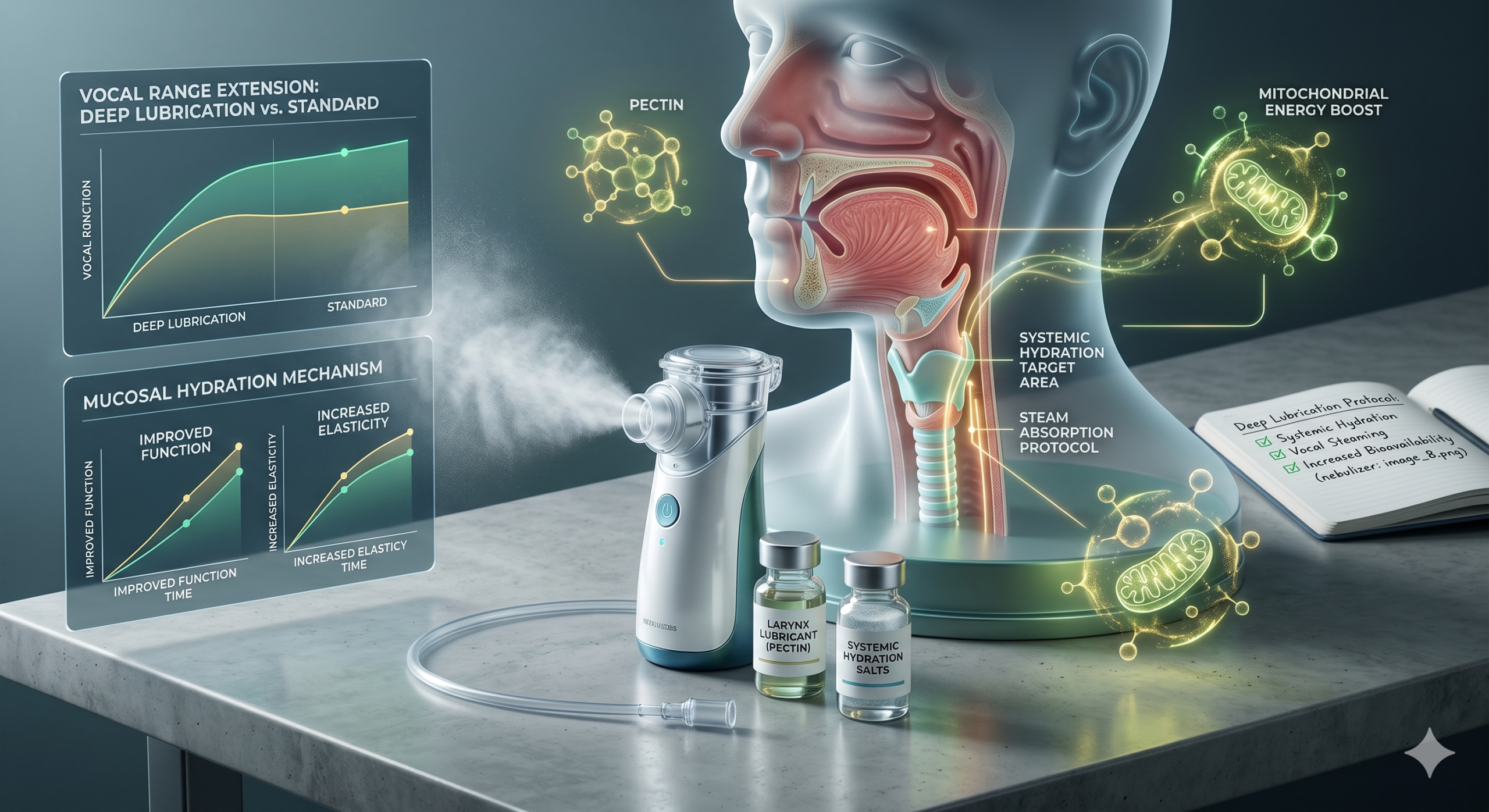
By combining systemic hydration, targeted airway support, and professional inhalation, understanding the core vocal steaming benefits for singers changes everything. This protocol dramatically improves mucosal elasticity, reduces phonatory effort, and unlocks a freer, more resonant vocal range.
Professional vocalists often obsess over microphones, warm-ups, supplements, and expensive vocal coaches while ignoring one of the most important variables in vocal performance: the hydration state of the vocal folds themselves.
The reality is simple: dry vocal folds cannot vibrate efficiently.
When the delicate mucosal layer covering the vocal folds becomes dehydrated, the voice loses flexibility, endurance, resonance, and upper-range freedom. High notes become harder to access. Sustained phrases require more effort. Subtle swelling increases friction during vibration. Over time, this creates the perfect environment for strain and injury.
This is where the Deep Lubrication Protocol changes everything.
By combining systemic hydration, targeted vocal steaming, and intelligent airway support, singers can dramatically improve vocal elasticity, reduce phonatory effort, and unlock a freer, more resonant vocal range.
Table of Contents
The Great Anatomical Myth: Water Does Not Touch Your Vocal Cords
One of the biggest myths in singing culture is the idea that drinking water directly “hits” the vocal cords.
Anatomically, that is impossible.
If water actually entered the airway and touched the vocal folds during swallowing, you would immediately cough or choke. The body is designed to prevent liquids from entering the larynx.
When you drink water, it travels down the esophagus into the stomach — not into the trachea where the vocal folds live.
So why does drinking water help the voice?
Because hydration happens systemically.
Your body absorbs water through the digestive system, distributes it through the bloodstream, and eventually supplies moisture to the glands and tissues surrounding the vocal mechanism. These glands produce the thin mucosal coating that allows the vocal folds to oscillate smoothly and efficiently.
Think of the vocal folds like violin strings coated with microscopic gel. When properly lubricated, vibration becomes effortless. When dry, friction increases dramatically.
This explains why:
- Chugging water right before singing rarely fixes dryness instantly
- Some singers feel vocally dry despite drinking during a performance
- Chronic dehydration silently reduces vocal stamina
- Air travel, caffeine, alcohol, and poor sleep wreck vocal quality
Hydration is not a last-minute trick.
It is a full-body physiological process.
The 4-Hour Rule: Why “Emergency Water Drinking” Fails
Elite vocal therapists often teach what many singers call the “4-Hour Rule.”
The principle is simple:
The water you drink now may take several hours to meaningfully improve vocal fold lubrication.
After ingestion, water must:
- Be absorbed by the digestive tract
- Enter circulation
- Reach tissues throughout the body
- Support mucus production in the laryngeal glands
This is why singers who spend all day dehydrated and suddenly start drinking water 15 minutes before a performance usually remain vocally stiff.
The body cannot instantly reverse tissue dehydration.
Signs of Poor Systemic Vocal Hydration
Many singers fail to recognize early dehydration because the symptoms are subtle at first:
- Sticky saliva
- Frequent throat clearing
- Reduced vocal flexibility
- Breathiness in upper notes
- Increased effort during belting
- Faster vocal fatigue
- Sensation of “tightness”
- Reduced resonance
- Delayed vocal recovery after rehearsals
By the time dryness becomes obvious, vocal efficiency has already dropped.
Systemic Hydration Strategies for Singers
Professional touring vocalists often treat hydration like athletes treat recovery.
Here are practical backstage strategies that actually work:
Start Hydration Early
Begin hydrating heavily in the morning if you sing at night.
Do not wait until soundcheck.
Use Electrolytes Intelligently
Water alone is not always enough. Electrolytes help retain fluid balance inside tissues.
Especially important after:
- Sweating
- Flights
- Intense rehearsals
- Alcohol consumption
- Long performances
Monitor Urine Color
Pale straw-colored urine is typically a good hydration sign.
Dark yellow urine usually indicates underhydration.
Reduce Hidden Dehydrators
Common vocal dehydrators include:
- Excess caffeine
- Alcohol
- Smoking
- High sodium intake
- Antihistamines
- Sleep deprivation
- Dry hotel air
- Airplane cabins
The voice often reflects systemic stress long before the body feels exhausted.
Vocal Steaming: The Only Instant Hydration for the Vocal Folds
While drinking water hydrates indirectly, inhalation hydrates directly. Unlocking these targeted vocal steaming benefits for singers represents one of the most powerful and scientifically validated tools in modern voice care.”
When warm water vapor is inhaled through the mouth and nose, microscopic moisture particles travel into the airway and temporarily increase surface hydration of the vocal folds.
Unlike drinking water, this process bypasses digestion entirely.
That is why singers frequently experience immediate relief after steaming.
The Immediate Vocal Steaming Benefits for Singers
Proper vocal steaming may help:
- Reduce vocal fold dryness
- Improve mucosal wave flexibility
- Decrease phonatory effort
- Soothe irritated tissues
- Reduce friction during singing
- Improve resonance sensation
- Support vocal recovery after performances
Many Broadway performers, touring artists, and elite broadcasters leverage the vocal steaming benefits for singers routinely to safeguard their income before and after high-pressure performances.
The Science Behind Steam and Vocal Efficiency
The vocal folds vibrate hundreds of times per second.
When adequately lubricated, the mucosal wave remains smooth and elastic.
When dry:
- Collision force increases
- Tissue stress rises
- Swelling risk increases
- Range becomes unstable
- High notes become harder
Steam helps temporarily restore surface moisture and improve tissue pliability.
This is especially useful in dry climates, air-conditioned venues, hotels, airplanes, or after heavy vocal use.
Safe Protocols to Maximize Vocal Steaming Benefits for Singers
The safest and most efficient clinical delivery methods include utilizing an ultrasonic isotonic vocal mist nebulizer or specialized personal steamers. Traditional steam can sometimes overheat tissues, whereas advanced handheld nebulizers deliver a precise, room-temperature isotonic saline mist that matches the body’s natural chemistry perfectly.
Important safety notes:
- Steam should be warm, not scalding
- Never inhale boiling vapor aggressively
- Sessions of 5–10 minutes are often sufficient
- Hydration effects are temporary and should complement systemic hydration
Overheating tissues can irritate the airway rather than help it.
Gentle consistency works better than extreme heat.
Peppermint and Eucalyptus: Airway Support for Vocal Recovery
Many singers use peppermint and eucalyptus strategically before performances.
When used correctly and safely, these aromatic compounds may help create the sensation of easier airflow and reduced upper-airway congestion.
However, there is an important distinction:
They do not magically “coat” the vocal folds.
Instead, they primarily affect airway sensation, nasal openness, and perceived breathing ease.
Peppermint Oil Benefits for Singers
Peppermint contains menthol, which activates cold-sensitive receptors in the airway.
This may create sensations of:
- Improved airflow
- Easier breathing
- Reduced throat tension
- Increased respiratory comfort
For some singers, this psychological and sensory effect reduces performance anxiety and unnecessary laryngeal squeezing.
Eucalyptus and Airway Relaxation
Eucalyptus vapors are commonly used to:
- Promote nasal openness
- Reduce congestion sensations
- Improve breathing comfort
- Support post-performance recovery
Singers who deal with allergies, travel fatigue, or mild irritation often find eucalyptus steaming especially soothing.
Important Safety Warning
Essential oils must be used carefully.
Overly concentrated oils can irritate the airway and worsen dryness.
Best practices include:
- Using only a few drops
- Avoiding direct ingestion
- Never applying undiluted oils inside the throat
- Discontinuing use if irritation occurs
For sensitive singers, plain steam alone may work best.
The 3-Step Pre-Show Vocal Lubrication Protocol
The best vocal performances are prepared hours before the audience arrives.
Here is a practical singer-friendly protocol used by many professional performers.
Morning: Heavy Systemic Hydration
This phase prepares the body internally.
Morning Checklist
- Drink water steadily throughout the morning
- Add electrolytes if needed
- Eat hydrating foods:
- Cucumbers
- Watermelon
- Citrus fruits
- Berries
- Limit excessive caffeine
- Avoid alcohol entirely on performance days
- Prioritize sleep recovery
Goal:
Create full-body hydration long before vocal demand increases.
Afternoon: Vocal Steaming and Recovery
This is where direct hydration begins.
Afternoon Steaming Routine
- Steam for 5–10 minutes
- Use warm, gentle vapor
- Breathe calmly through mouth and nose
- Avoid excessive talking afterward
- Rest the voice when possible
Optional additions:
- Mild eucalyptus aroma
- Peppermint diffusion in the room
- Humidifier backstage or in hotel rooms
Goal:
Reduce tissue dryness before vocal load increases.
30 Minutes Before Show Time: Warm-Up and Protection
This stage activates the vocal mechanism without overloading it.
Final Pre-Show Routine
- Gentle lip trills
- Resonance exercises
- Soft sirens
- Semi-occluded vocal tract exercises
- Controlled breath activation
- Light stretching for neck and jaw
Avoid:
- Aggressive belting
- Yelling backstage
- Whispering
- Excess throat clearing
- Ice-cold drinks
Many elite singers also reduce unnecessary conversation before performances to conserve vocal energy.
Goal:
Wake up the voice without triggering inflammation.
Why Lubrication Expands Vocal Range
Many singers mistakenly think vocal range is purely muscular.
In reality, vocal freedom depends heavily on tissue flexibility and vibration efficiency.
A dry larynx creates resistance.
A lubricated larynx creates fluidity.
When the vocal folds are properly hydrated:
- High notes require less force
- Registers transition more smoothly
- Resonance improves
- Sustain becomes easier
- Recovery accelerates
- Tone becomes richer
- Fatigue decreases
This is why some singers suddenly “find” notes after steaming or proper hydration.
The notes were never missing.
The tissue conditions were limiting access.
The Hidden Link Between Stress and Vocal Dryness
Holistic voice therapy recognizes something modern singers often overlook:
Stress dehydrates the voice.
Chronic sympathetic nervous system activation reduces saliva production, increases muscular tension, alters breathing mechanics, and contributes to subtle throat constriction.
This explains why anxious singers often feel:
- Dry throat
- Tight jaw
- Reduced range
- Breathy onset
- Shaky tone
Deep breathing, sleep optimization, nervous system regulation, and emotional relaxation are all part of vocal lubrication.
A calm body supports a resonant voice.
Conclusion: A Powerful Voice Is a Well-Lubricated Voice
The greatest singers in the world are not simply loud.
They are efficient.
And vocal efficiency begins with lubrication.
True vocal freedom comes from understanding that the voice is biological tissue requiring hydration, recovery, and intelligent care. Drinking water randomly before a performance is not enough. Sustainable vocal power depends on systemic hydration, strategic steaming, airway support, and disciplined preparation.
The Deep Lubrication Protocol works because it respects vocal physiology instead of fighting against it.
When the mucosal lining of the vocal folds remains supple, elastic, and hydrated, the voice becomes more stable, flexible, resonant, and expansive.
High notes feel freer.
Transitions become smoother.
Fatigue decreases.
And the singer finally experiences what every great performance demands:
Effortless vibration.
vocal steaming benefits for singers
2 comentários em “The Deep Lubrication Protocol: How Systemic Hydration and Vocal Steaming Unlock Your True Vocal Range”