In the modern world, most people carefully track their nutrition, workouts, hydration, and supplements—but ignore one of the most biologically powerful inputs affecting human performance: light.
Your brain does not care what your smartwatch says. It cares what your eyes tell it about the sun.
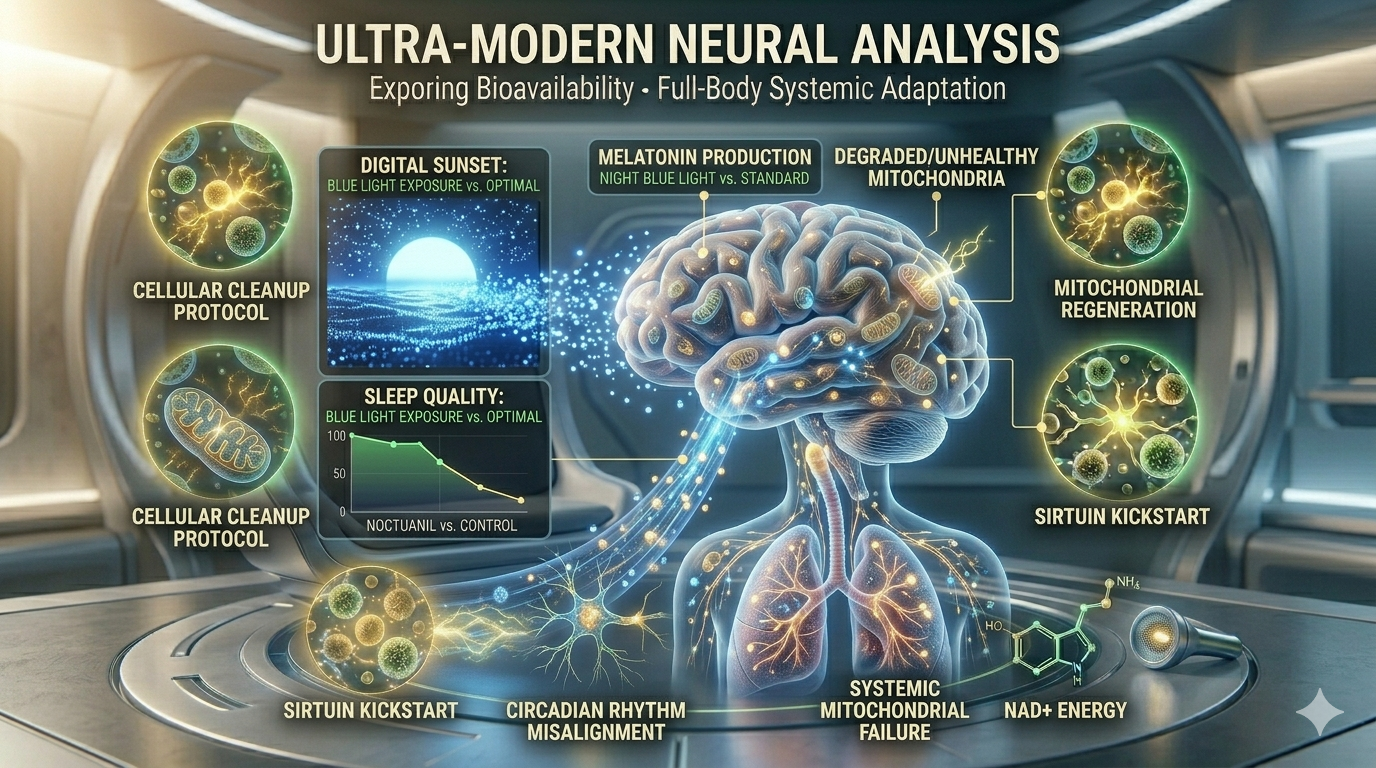
And every single night, millions of people unknowingly sabotage their hormonal recovery, cellular repair, and metabolism simply because the aggressive impact of artificial blue light at night sleep quality degradation prevents their brain from entering deep, restorative sleep.
This is where the concept of the Digital Sunset becomes one of the most important biohacking strategies for high performance.
The Digital Sunset is the intentional reduction of artificial blue light exposure after sunset in order to restore the body’s natural circadian rhythm. In simple terms, it means teaching your nervous system that nighttime has actually arrived.
Most people finish their day under intensely bright LED lights while staring directly into phones, televisions, tablets, and laptops until the moment they fall asleep. Biologically, this is equivalent to telling the brain that it is still midday.
The result?
- Suppressed melatonin production
- Elevated evening cortisol
- Fragmented sleep architecture
- Reduced deep sleep
- Poor mitochondrial regeneration
- Morning fatigue and brain fog
If you constantly wake up tired despite getting “enough hours” of sleep, your problem may not be sleep duration—it may be your relationship with light.
Table of Contents
How Blue Light at Night Sleep Quality Disruptions Confuse the Brain
Human biology evolved under two primary lighting conditions for thousands of years:
- Bright blue-enriched sunlight during the day
- Warm amber and firelight after sunset
Modern artificial lighting completely breaks this evolutionary pattern.
LED bulbs, smartphones, televisions, and computer screens emit strong wavelengths of blue light, particularly in the 450–490 nanometer range. During daylight hours, this spectrum is beneficial. It increases alertness, reaction time, dopamine activity, and cognitive performance.
But at night, it becomes biologically disruptive.
Inside the retina are specialized photoreceptor cells called intrinsically photosensitive retinal ganglion cells (ipRGCs). These cells are extremely sensitive to blue light and communicate directly with the brain’s master clock, the suprachiasmatic nucleus (SCN), located in the hypothalamus.
When blue light hits the eyes at night, the SCN interprets the signal as daylight.
Your brain then initiates a cascade of wakefulness signals:
- Melatonin production drops
- Cortisol remains elevated
- Body temperature stays higher
- Dopamine signaling shifts
- Sleep pressure weakens
This is why scrolling on your phone at 11 PM can make you feel artificially awake even when your body is exhausted.
Your nervous system has essentially been tricked into believing sunset never happened.
Melatonin: More Than a Sleep Hormone
Most people think melatonin simply helps you fall asleep.
That is an oversimplification.
Melatonin is one of the body’s most powerful mitochondrial protective molecules.
It acts as:
- A circadian timing signal
- A potent antioxidant
- A regulator of mitochondrial efficiency
- A cellular repair coordinator
At night, melatonin production naturally rises in darkness. This hormone helps orchestrate the transition into deep, restorative sleep while simultaneously activating nighttime cellular maintenance processes.
Exposing your retinas to artificial blue light at night sleep quality processes drops your melatonin baseline drastically. Even relatively brief exposure to bright phone screens reduces this vital protective molecule significantly.
This creates a biological contradiction:
Your body is physically tired, but neurologically stuck in “day mode.”
The consequences extend far beyond poor sleep.
How Blue Light Disrupts Mitochondrial Regeneration
Mitochondria are often called the “power plants” of the cell, but their role is far more sophisticated than simply generating energy.
They regulate:
- ATP production
- Cellular signaling
- Oxidative stress balance
- Inflammation
- Recovery capacity
- Aging processes
During deep sleep—particularly slow-wave sleep—the body initiates critical repair and regeneration pathways that directly affect mitochondrial health.
This is when the brain performs large-scale maintenance tasks such as:
- Cellular detoxification
- Synaptic recalibration
- Oxidative damage repair
- Glymphatic waste clearance
- Mitochondrial restoration
Fragmented sleep interrupts these recovery phases.
And ignoring the damage of blue light at night sleep quality structural balance is one of the fastest ways to fragment sleep architecture. You may still fall asleep after scrolling social media, but cellular repair is gone.
Research in chronobiology consistently shows that nighttime light exposure can:
- Reduce deep sleep duration
- Delay REM onset
- Increase nighttime awakenings
- Lower overall sleep efficiency
- Increase next-day fatigue
The mitochondria never receive the uninterrupted recovery window they require.
Over time, this may contribute to:
- Brain fog
- Low motivation
- Reduced exercise recovery
- Hormonal dysregulation
- Increased inflammation
- Accelerated biological aging
In biohacking terms, poor nighttime light hygiene quietly drains your metabolic battery every single day.
The Digital Sunset Protocol
The solution is not complicated.
You do not need expensive sleep technology or advanced supplements to dramatically improve sleep quality.
You need darkness signals.
Below is a practical Digital Sunset Protocol designed to protect melatonin production and optimize nighttime mitochondrial recovery.
Blue-Blocking Glasses
One of the most effective tools for protecting circadian biology is utilizing certified premium blue light blocking glasses. These clinical-grade lenses filter out destructive wavelengths before they reach the retina, allowing your brain to produce melatonin naturally after dark.
For maximum effectiveness, use glasses with:
- Amber lenses for moderate evening protection
- Deep red lenses for aggressive melatonin protection
- High blue-light filtration percentages
When to Wear Them
The ideal timing is:
- Approximately 2–3 hours before bed
- Especially after sunset
- During screen exposure at night
For example:
If you plan to sleep at 10:30 PM, begin wearing blue-blocking glasses around 7:30–8:00 PM.
How Red Lenses Protect Against Blue Light at Night Sleep Quality Issues
Red and deep amber lenses block more short-wavelength blue light than clear “computer glasses.”
This matters because circadian disruption is specifically triggered by blue-spectrum light.
Many cheap blue-light glasses only reduce eye strain while providing minimal circadian protection.
For mitochondrial recovery and sleep optimization, stronger filtration matters.
Additional Benefits Reported by Users
People who consistently use nighttime blue blockers often report:
- Faster sleep onset
- Deeper sleep
- More vivid dreams
- Improved morning alertness
- Reduced evening anxiety
- Better recovery from training
The effect is frequently noticeable within just a few nights.
Environmental Lighting
Most modern homes are biologically designed like operating rooms.
Bright white LEDs flood the nervous system with artificial daylight signals long after sunset.
One of the simplest upgrades you can make is transforming your nighttime environment into a biologically appropriate lighting ecosystem.
Evening Lighting Rules
After sunset:
- Dim overhead lights
- Avoid cool white LEDs
- Use warm amber lighting instead
- Prefer lamps over ceiling lights
- Lower brightness whenever possible
Think “candlelight environment,” not “office environment.”
Best Lighting Colors for Night
Optimal evening lighting includes:
- Warm yellow
- Amber
- Orange
- Red-spectrum light
These wavelengths are far less disruptive to melatonin production.
Powerful Low-Tech Biohacks
Consider adding:
- Salt lamps
- Red-light bulbs
- Smart bulbs with sunset automation
- Motion-sensitive dim lighting for bathrooms
- Candlelight during late evening relaxation
Even small environmental changes can dramatically reduce circadian stress.
Device Rules
No sleep protocol will work if you spend your final hour before bed blasting your retinas with social media and high-intensity screen light.
Your devices need boundaries.
Activate Night Mode
Every device should be configured with:
- Night Shift
- Blue-light reduction mode
- Warm color temperature settings
- Automatic sunset scheduling
This is not perfect protection, but it is significantly better than default settings.
Reduce Screen Brightness
Brightness intensity matters almost as much as color spectrum.
At night:
- Lower screen brightness aggressively
- Avoid using devices in dark rooms at full brightness
- Increase ambient warm lighting if screens must be used
The Golden Rule: No Screens One Hour Before Bed
This is the most powerful rule in the entire protocol.
At least 60 minutes before sleep:
- No phones
- No tablets
- No laptops
- No television
Instead, replace screen stimulation with:
- Reading physical books
- Stretching
- Journaling
- Breathwork
- Prayer or meditation
- Low-light conversation
This creates a neurochemical transition into sleep rather than forcing the brain to abruptly shut down from a hyperstimulated state.
Why Morning Energy Starts the Night Before
Most people try to fix low energy with caffeine.
But energy is largely created during recovery.
Deep sleep is when the nervous system recalibrates, hormones synchronize, and mitochondria restore energy-producing capacity.
If artificial light destroys the quality of that recovery window, no amount of coffee fully compensates for it.
This is why elite performers, athletes, and longevity-focused biohackers increasingly prioritize circadian biology as a foundational pillar of performance optimization.
Because the quality of your morning begins with the quality of your darkness.
Conclusion: Try the Digital Sunset for 3 Nights
You do not need to become a monk or eliminate technology from your life.
You simply need to reintroduce biological nighttime signals into your environment.
For the next three nights, test this protocol:
- Dim your lights after sunset
- Wear blue-blocking glasses
- Turn devices to night mode
- Stop screen exposure one hour before bed
Then pay attention to:
- How quickly you fall asleep
- How deeply you sleep
- Your dreams
- Your morning clarity
- Your daytime energy levels
Most people are shocked by how dramatic the difference feels.
The modern world has normalized circadian disruption so thoroughly that many people no longer remember what genuinely restorative sleep feels like.
Your mitochondria remember.
And when you give your biology darkness again, your body often responds with deeper sleep, sharper cognition, stronger recovery, and a level of morning energy that caffeine alone can never create.
3 comentários em “The Digital Sunset: How Blue Light at Night Destroys Mitochondrial Regeneration and Sleep Quality”