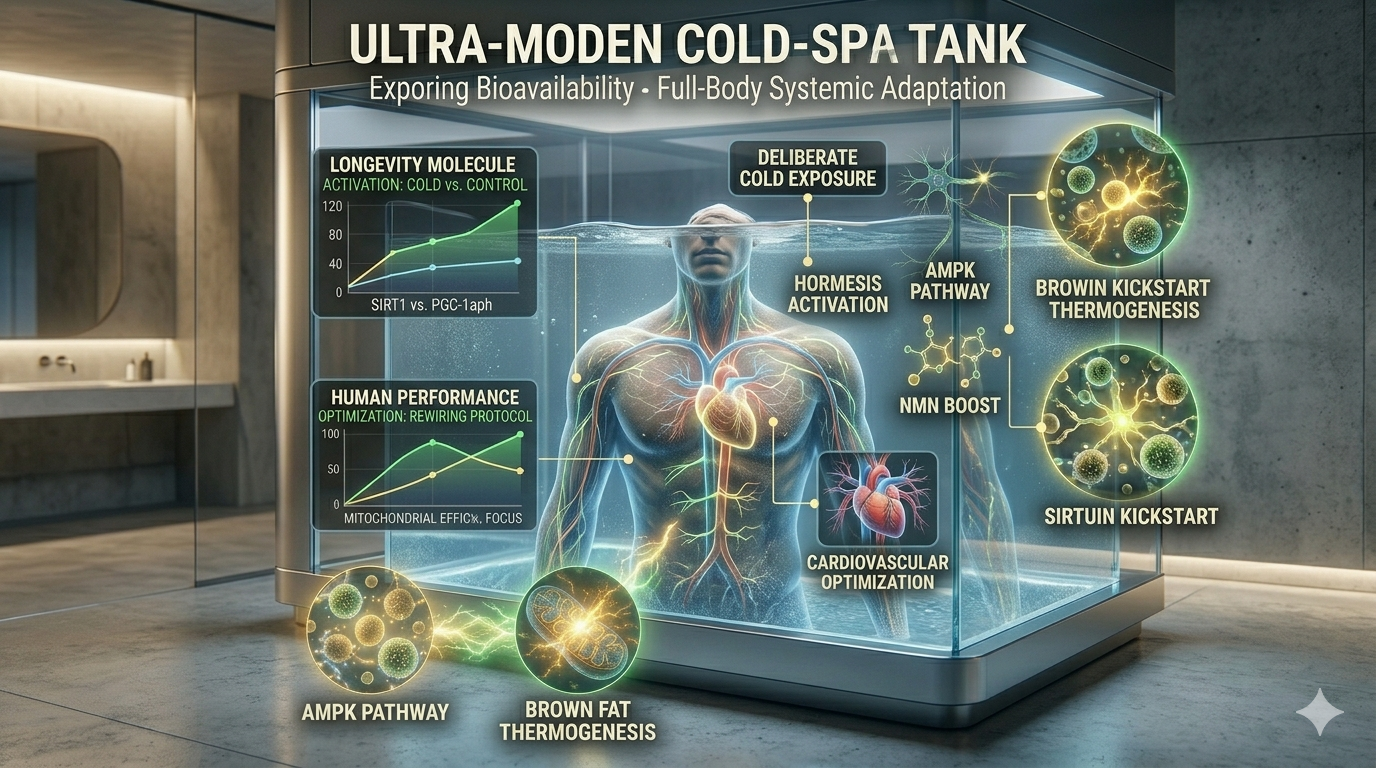
Introduction: America’s Ice Bath Obsession Is More Than a Recovery Trend
Across the United States, cold plunges have evolved from niche athletic recovery tools into one of the most influential biohacking rituals in modern wellness culture. From Silicon Valley executives and UFC fighters to longevity researchers and high-performance entrepreneurs, deliberate cold exposure has become synonymous with resilience, metabolic optimization, and cognitive enhancement.
Social media often portrays ice baths as merely a test of mental toughness or a strategy to reduce post-workout soreness. But the emerging science tells a much deeper story, proving that targeted cold exposure longevity benefits are driven by a powerful cellular stressor capable of activating ancient survival pathways embedded within human physiology.
When the body encounters cold water immersion, it triggers a cascade of adaptive responses involving mitochondria, neurotransmitters, thermogenic fat, inflammatory signaling pathways, and even proteins associated with brain preservation and longevity.
This process is known as hormesis — the biological phenomenon where short, controlled stress exposures make the organism stronger and more resilient over time.
In many ways, cold plunging functions like exercise for your cells. To safely navigate this environmental challenge, utilizing structured biohacking physical performance guides and professional recovery blueprints allows you to maximize cellular gains without triggering excessive central nervous system exhaustion.
Researchers are now investigating how deliberate cold exposure may influence:
- Metabolic flexibility
- Mitochondrial biogenesis
- Insulin sensitivity
- Dopamine regulation
- Neuroprotection
- Inflammation control
- Healthy aging pathways
The most fascinating discovery is that unlocking targeted cold exposure longevity benefits appears to stimulate several molecular pathaways linked to cellular resilience — helping explain why humans exposed to controlled environmental stress display improved healthspan.
Table of Contents
Brown Adipose Tissue (BAT): How Cold Exposure Reprograms Human Fat
One of the most significant biological effects of cold plunging is the activation of Brown Adipose Tissue (BAT), commonly known as brown fat.
Unlike ordinary white fat, which primarily stores excess calories, brown fat is metabolically active and densely packed with mitochondria — the energy-producing structures inside cells.
These mitochondria contain high amounts of iron-rich proteins, giving brown fat its darker appearance.
White Fat vs. Brown Fat
White Adipose Tissue (WAT)
White fat mainly functions as:
- Energy storage
- Hormonal signaling
- Insulation
Excessive white fat accumulation is associated with:
- Insulin resistance
- Chronic inflammation
- Cardiovascular disease
- Metabolic dysfunction
Brown Adipose Tissue (BAT)
Brown fat behaves differently:
- Burns calories to generate heat
- Enhances thermogenesis
- Improves glucose metabolism
- Increases energy expenditure
BAT acts almost like a built-in metabolic furnace.
When exposed to cold temperatures, the sympathetic nervous system releases norepinephrine, which activates brown fat cells. These cells then increase mitochondrial activity and generate heat through a protein called UCP1 (Uncoupling Protein 1).
The “Fat Browning” Phenomenon
Perhaps even more impressive is the discovery that cold exposure may stimulate the conversion of white fat into “beige fat,” a process often referred to as fat browning.
Beige fat shares many characteristics with brown fat, including:
- Increased mitochondrial density
- Higher caloric expenditure
- Improved metabolic efficiency
This metabolic transformation highlights why regular cold exposure longevity benefits include enhanced insulin sensitivity, superior metabolic flexibility, improved body composition, and a drastic reduction in visceral fat.
Some researchers believe BAT activation may become a major therapeutic target for obesity and metabolic disease in the coming decades.
Cold Exposure Longevity Benefits via Brain-Protective RBM3 Proteins
One of the most exciting areas of cold exposure research involves the activation of cold shock proteins.
These specialized proteins are produced when the body experiences lower temperatures and appear to play protective roles in cellular survival and neurological integrity.
Among them, one molecule has gained major attention in neuroscience:
RBM3 (RNA-Binding Motif Protein 3)
RBM3 is considered a neuroprotective cold shock protein associated with:
- Synaptic regeneration
- Brain cell preservation
- Cognitive resilience
- Protection against neurodegeneration
Animal studies have shown that cooling the body can increase RBM3 expression, helping preserve neural connections under stress conditions.
Why This Matters for Aging
Aging is strongly associated with:
- Synaptic loss
- Cognitive decline
- Neuroinflammation
- Reduced neuronal plasticity
RBM3 appears to help maintain communication between neurons, potentially slowing aspects of neurological deterioration.
Researchers investigating diseases such as:
- Alzheimer’s disease
- Parkinson’s disease
- Dementia
have become increasingly interested in cold-induced neuroprotective pathways.
Although human research is still evolving, the evidence suggests that strategic cold exposure may stimulate adaptive mechanisms that preserve brain function over time.
Cold Exposure as Cellular Conditioning
Cold immersion also activates broader cellular defense systems, including:
- Heat shock proteins
- Antioxidant pathways
- DNA repair mechanisms
- Autophagy-related signaling
Autophagy, often described as the body’s “cellular cleanup system,” helps remove damaged proteins and dysfunctional cellular components.
This process is strongly associated with longevity science because cellular waste accumulation is a hallmark of aging.
By triggering mild biological stress, cold exposure may encourage the body to:
- Repair itself more efficiently
- Enhance stress tolerance
- Maintain cellular integrity longer
In other words, brief discomfort may stimulate long-term biological resilience.
Dopamine, Adrenaline, and Mental Resilience: Why Cold Plunges Feel Psychologically Transformative
Many people report feeling:
- More alert
- Emotionally stable
- Motivated
- Mentally sharp
after a cold plunge.
This effect is not psychological imagination. It is deeply rooted in neurochemistry.
The Dopamine Effect
Research has shown that cold exposure can produce a dramatic increase in dopamine levels.
Dopamine is a neurotransmitter associated with:
- Motivation
- Focus
- Drive
- Mood regulation
- Reward processing
Unlike stimulants such as caffeine, nicotine, or high-sugar foods, cold exposure appears to elevate dopamine in a sustained and relatively stable manner.
Some studies suggest dopamine may increase by over 200% following cold immersion, with effects lasting several hours.
The key distinction is that cold exposure does not appear to create the same rapid overstimulation-and-crash cycle commonly associated with stimulants.
Instead, the body gradually adapts to the stressor while maintaining heightened alertness.
Adrenaline Without Chaos
Cold exposure also activates:
- Epinephrine (adrenaline)
- Norepinephrine
These catecholamines enhance:
- Attention
- Reaction speed
- Mental clarity
- Energy mobilization
However, repeated exposure appears to improve autonomic nervous system regulation over time.
This means practitioners often develop:
- Greater stress tolerance
- Reduced emotional reactivity
- Improved resilience under pressure
Building Psychological Toughness
There is also a behavioral dimension to cold plunging.
Entering freezing water requires:
- Emotional regulation
- Breath control
- Nervous system discipline
Each session becomes a form of deliberate discomfort training.
This repeated exposure teaches the brain an important lesson:
Stress does not automatically equal danger.
Over time, this can improve one’s ability to remain calm during:
- High-pressure work situations
- Emotional conflict
- Athletic performance
- Financial stress
- Unexpected adversity
For many biohackers and performance professionals, the psychological adaptation may be just as valuable as the physiological benefits.
The Anti-Inflammatory Effects of Deliberate Cold Exposure
Inflammation is one of the central drivers of modern chronic disease.
Persistent low-grade inflammation is linked to:
- Cardiovascular disease
- Type 2 diabetes
- Neurodegeneration
- Depression
- Autoimmune disorders
- Accelerated aging
Cold exposure may help regulate inflammatory signaling through several mechanisms.
Vasoconstriction and Recovery
Cold water causes blood vessels to constrict temporarily, reducing:
- Tissue swelling
- Fluid accumulation
- Inflammatory activity
Once the body rewarms, circulation increases again, potentially improving nutrient delivery and waste removal.
This explains why athletes commonly use cold immersion for:
- Recovery
- Pain management
- Reduced soreness
Cytokine Modulation
Research also suggests cold exposure may influence inflammatory cytokines such as:
- TNF-alpha
- IL-6
- C-reactive protein
While excessive cold stress can become harmful, properly dosed exposure may help improve immune regulation and inflammatory balance.
The key principle is dosage.
In biohacking, more stress is not always better.
The goal is controlled adaptation — not exhaustion.
Beginner Protocols to Activate Cold Exposure Longevity Benefits Safely
One of the biggest misconceptions about cold exposure is that extreme temperatures are necessary.
In reality, most benefits occur well before water reaches dangerous levels.
For beginners, consistency matters far more than intensity.
Recommended Starting Temperature
A practical beginner range is:
- 50–59°F (10–15°C)
This temperature is cold enough to stimulate adaptation while remaining manageable for most healthy adults.
Recommended Duration
Start with:
- 2–3 minutes per session
As adaptation improves, some individuals gradually progress toward:
- 5–10 minutes
Longer is not necessarily better.
Excessive exposure can:
- Increase recovery demands
- Elevate stress hormones excessively
- Raise hypothermia risk
Breathing Is Critical
The initial cold shock response often triggers:
- Hyperventilation
- Rapid breathing
- Panic sensations
Focus on:
- Slow nasal breathing
- Controlled exhalations
- Relaxing the shoulders and jaw
The goal is to teach the nervous system to remain regulated under stress.
Frequency Guidelines
Most evidence-based protocols recommend:
- 2–5 sessions per week
Daily cold exposure may work for some individuals, but recovery capacity varies significantly.
Important Safety Considerations
Cold plunging is not appropriate for everyone.
Individuals with:
- Cardiovascular disease
- Uncontrolled hypertension
- Arrhythmias
- Raynaud’s disease
- Certain neurological conditions
should consult a healthcare professional before attempting deliberate cold exposure.
Never practice prolonged cold immersion alone.
Avoid combining:
- Alcohol
- Extreme fasting
- Exhaustive exercise
- Prolonged cold exposure
especially as a beginner.
Why Hormetic Stress May Be the Missing Piece of Modern Health
Modern life has become biologically comfortable.
Climate-controlled environments, endless food access, and reduced physical stress have eliminated many of the environmental challenges humans evolved to handle.
Ironically, this constant comfort may contribute to metabolic fragility.
Humans evolved under conditions involving:
- Temperature fluctuations
- Food scarcity
- Physical exertion
- Environmental unpredictability
Controlled stressors like:
- Exercise
- Sauna therapy
- Fasting
- Cold exposure
appear to reactivate ancient adaptive pathways that modern lifestyles suppress.
Cold plunging represents one of the most direct ways to engage these systems intentionally.
The objective is not suffering for its own sake.
The objective is adaptation.
Conclusion: Embracing Controlled Discomfort for Long-Term Health and Longevity
Cold plunging is far more than a social media wellness trend or a recovery ritual for elite athletes.
The science suggests deliberate cold exposure may influence some of the body’s most powerful biological systems, including:
- Brown fat activation
- Mitochondrial function
- Dopamine regulation
- Neuroprotection
- Inflammatory balance
- Cellular resilience pathways
By activating hormetic stress responses, cold exposure encourages the body to become more metabolically flexible, neurologically resilient, and psychologically adaptable.
The most compelling aspect of cold plunging is that it reconnects humans with a biological principle deeply embedded in evolution:
Short-term discomfort can produce long-term strength.
In a world increasingly engineered for convenience and comfort, deliberate cold exposure offers something rare — a scientifically grounded method of training the body and mind to become harder to break.
And in the pursuit of longevity, resilience may ultimately be the most valuable molecule of all.
1 comentário em “The Science of Cold Plunging: How Deliberate Cold Exposure Activates Longevity Molecules and Rewires Human Performance”